

Portugal’s River of Gold
10 Days | 8 Guided Tours | 2 Countries
Lisbon to Porto
FLASH DEALS
FREE Airfare
FREE Stateroom Upgrade
Reduced Fares
Offer ends January 18, 2026
Call 1-855-516-0653 for details
Ask for Offer "JVR26"
Portugal’s River of Gold
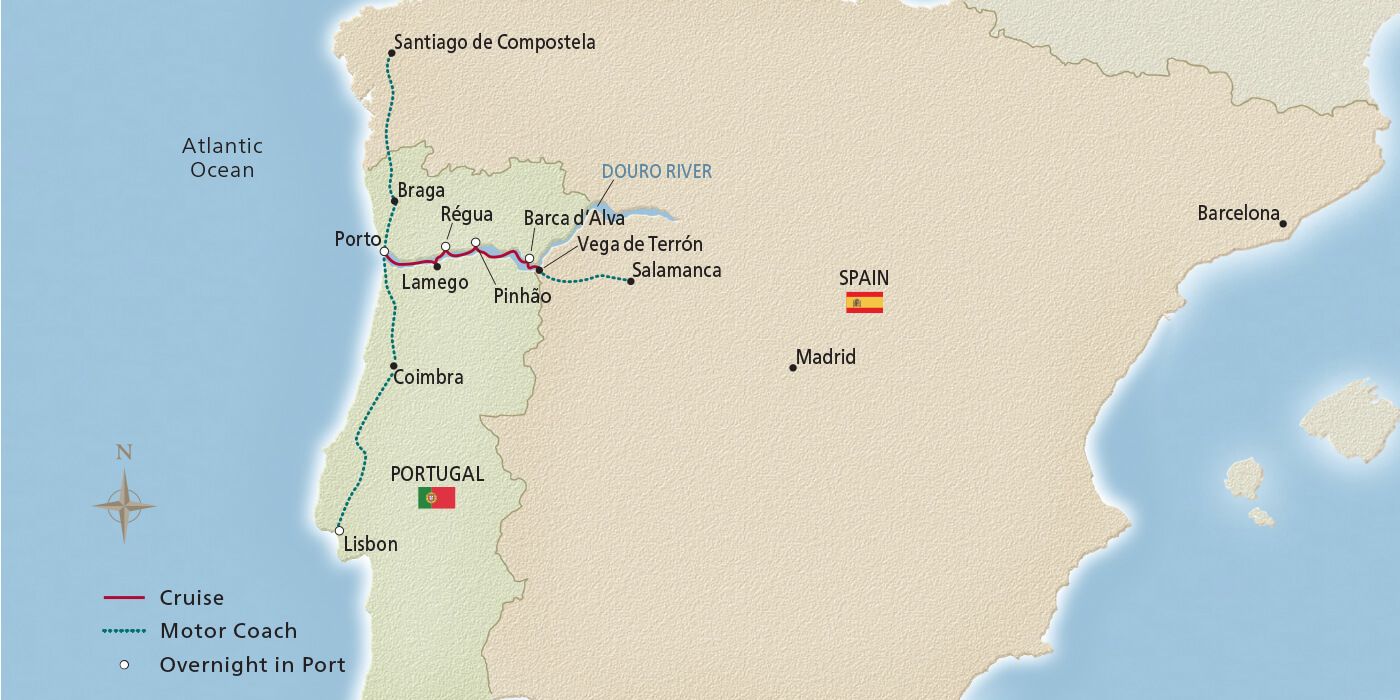
Arrive and check in to your hotel. Lisbon has inspired explorers for centuries with its stunning setting at the Tagus River’s mouth. Its labyrinthine streets carry echoes of 16th-century navigators who sailed on the winds of the Age of Discovery. The city prospered greatly from its trade. And today’s streets are lined with the legacies of wealthy builders, including the Jerónimos Monastery and Belém Tower, stunning works that introduced Manueline architecture. Savoring local cuisine and port wine are favorite pastimes here. On any evening, the strains of fado spill from clubs in the historic Alfama District.
Throughout Lisbon, fascinating monuments tell this proud city’s story. Along the riverfront, in Praça do Comércio, an equestrian statue at its center represents Portugal’s King José I, who capably rebuilt the city following the devastating 1755 earthquake. Among the most recognized of Lisbon’s monuments is the grand Monument to the Discoveries on the banks of the Tagus River, displaying statues of more than 30 contributors to exploration, whose bravery and spirit still shape the culture of this vibrant European capital.
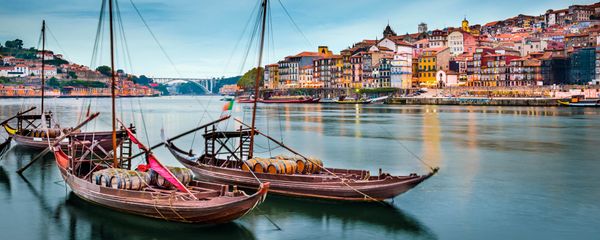
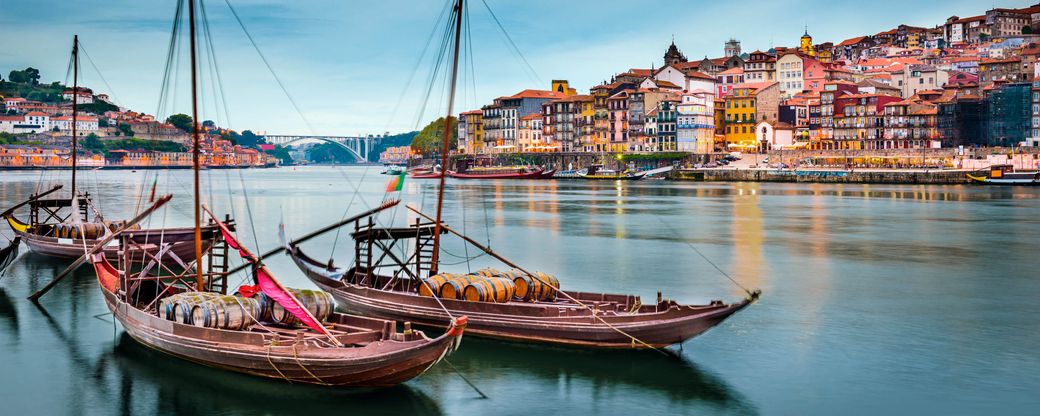
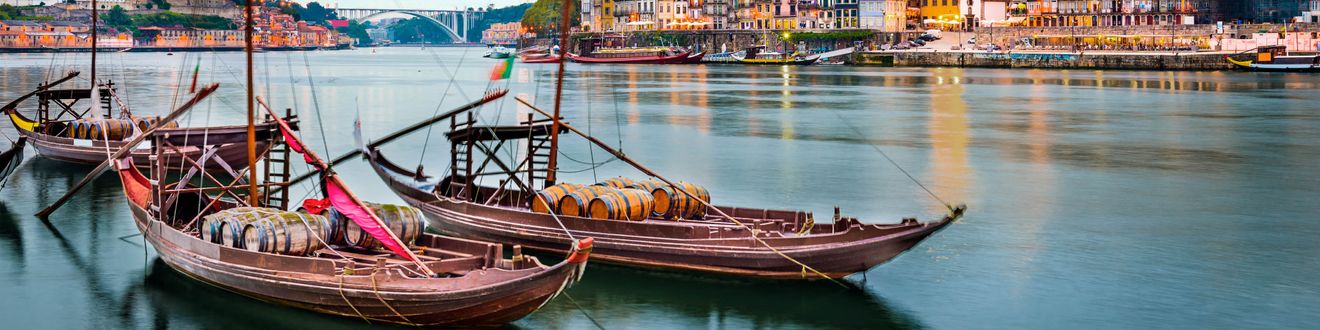
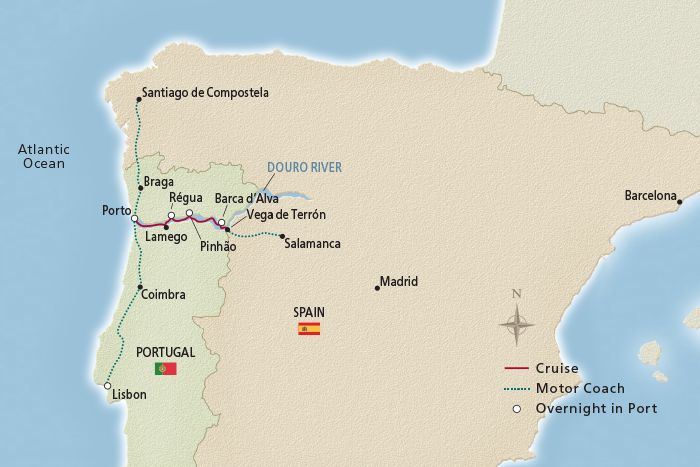
After breakfast, check out of your hotel and begin your journey to your embarkation city. Porto holds a place of great traditional importance. The town lends its name to the port wine produced in the region and throughout the nation. Located along a rocky embankment, the city boasts picturesque neighborhoods, fashionable restaurants and lively markets. Like Lisbon, Porto has a rich past; its historic center is a UNESCO World Heritage Site of narrow cobblestone streets brimming with romantic buildings spanning the centuries and a Romanesque cathedral. At the riverside, small barcos rabelos, boats once used to transport casks of wine, paint a charming scene.
The peaceful town of Peso da Régua, commonly known as Régua, overlooks the Douro River with the Serra do Marão mountains as a stunning backdrop. In 1756, the Marquês de Pombal proclaimed this city as the center of his newly demarcated wine region, and it has remained so since. As such, the town is steeped in the wine-making culture. This is particularly true at Casa do Douro, the headquarters of the Port Wine Institute. Its beautiful stained glass windows are a tribute in light and glass to the rich history of port wine and its cultural significance to the region.
Journey through the Douro River valley into the history of fine Portuguese wine. Surrounded by terraced hills, spot some of the area’s quintas, or wine estates, clinging to the slopes, nestled snugly among their vines. In this beautiful and largely unspoiled region, olive and almond groves share the river’s banks with vineyards. And it is hard to ignore the fact that this journey follows in the wake of traditional barcos rabelos that once transported wine downriver to the waiting casks in Vila Nova de Gaia.
Founded by a Celtic tribe before the rise of the Roman Empire, Salamanca was named a UNESCO World Heritage Site in 1988 due to its beautifully preserved buildings. It is home to one of Europe’s oldest universities, founded in 1134, and its main square, bustling with students, is often called the most beautiful in Spain. The beauty of this richly historic city, besides the enormous Romanesque cathedral whose profile dominates the town, is the grace with which Salamanca retains a traditional Spanish village feel. It is a living museum that takes visitors back to the Middle Ages.
The sleepy town of Pinhão is situated between the Douro and Pinhão Rivers, in the epicenter of the valley’s port wine-making region. The climate and growing conditions here are perfect for port grapes and the surrounding landscape, festooned with vineyards, creates a serene experience. The biggest names in port have quintas, or wine estates, nearby. During the annual grape harvest in autumn, the village comes to life, attracting workers and wine enthusiasts from across the whole of Europe.
With its historic place as the western boundary of the demarcated wine region of Portugal, Régua boasts a rich wine-making heritage. Riverside manor houses are occupied by winegrowers; some have draped their terraces with giant lettering so they can be easily identified from the water by passing ships. The country’s famous port was created when 16th-century British merchants added brandy to the local wine to prevent it from souring. Over the centuries, the process of maturing and blending has been perfected, resulting in appealing tawnies, rubies and other varieties.
The magnificent 19th-century Luís I Bridge, designed by a disciple of Gustave Eiffel and opened in 1886, spans the Douro River to link Porto to Vila Nova de Gaia. Known locally as “Gaia,” the city is central to Porto’s role as a major producer of port. Here, amid ceramic, glass and soap factories, cellars of 58 companies fortify the prized wine. Visiting Gaia offers insight into how Douro River valley wines are transformed into some of the most sought-after ports in the world, and provides panoramic views of Porto, as many of the cellars are located on the banks of the river.
Porto’s prosperous future was sealed when the distinctive, single-masted barcos rabelos delivered the first wine shipments here from vineyards up the Douro River. Before the advent of the railroad, these wooden cargo boats provided the fastest and most efficient transport of wines between the Douro River valley’s wineries and the city, from which bottles were exported all over the world. Today, the vessels are owned by port wine companies along the Douro. Though no longer in use, they still grace the river’s edge nonetheless, enriching the city’s character and cultural identity. After breakfast, disembark your ship and journey home.
Air Pricing
Prices are per person for featured departures.
Airfare offers valid on all N. American gateways except Alaska, Hawaii, San Juan and Mexico City.
Boston, Chicago, Dallas/Ft. Worth, Los Angeles, New York, San Francisco, Washington D.C.
Many additional gateways available, air fares may vary; call for details.
FREE Airfare
Offer valid on bookings made by January 18, 2026. FREE airfare & FREE Stateroom Upgrades (Cat F to Cat E, Cat D to Cat C and Cat B to Cat A) and Cat (V1-DV1) on The Big Easy to the Getaway City plus reduced fares only applicable to select departures of featured itineraries during stated sailing period. Offer is based on inventory availability at the time of purchase. 2026: Pay in by February 20, 2026 or at time of booking if within 120 days of departure. Free and Reduced Air offers not valid when booked from gateways in Alaska, Hawaii, Puerto Rico, or Mexico. Reduced Air offers vary by selected Air gateway in the country of residence. Airfares may vary on other gateways & departures. Air does not have to be purchased to receive cruise/cruisetour offer. Prices are based on double occupancy in US dollars and for US residents only. Offer may be withdrawn at any time without prior notice. All fares reflect cruise taxes, port taxes and fees. Not combinable with group contract pricing. Additional restrictions may apply.