

Cities of Light
12 Days | 10 Guided Tours | 4 Countries
Paris to Prague
WEEKEND SALE
FREE International Airfare
FREE Stateroom Upgrade
Special Fares
Offer ends December 21, 2025
Call 1-855-516-0653 for details
Ask for Offer "RM12"
Cities of Light
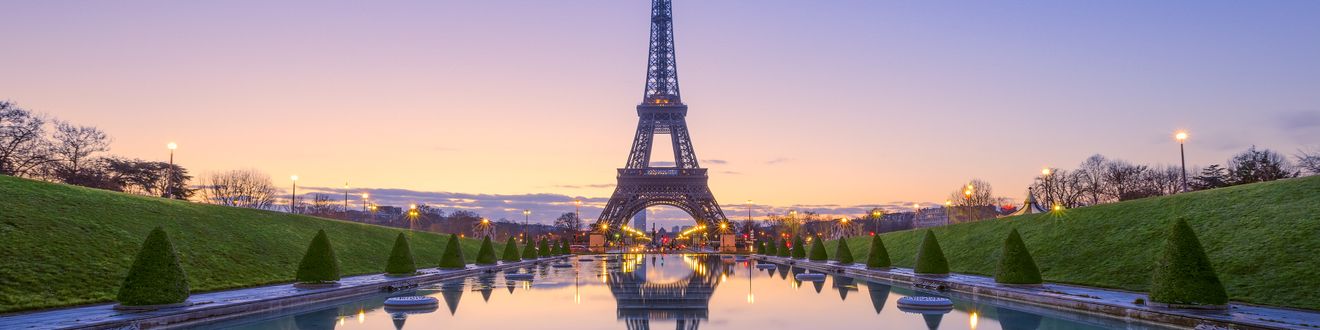
Arrive and check in to your hotel. Long a hub of French culture and cuisine, Paris is one of the most romantic destinations in the world. Over the centuries, Parisian culture has been built on the wings of inspiration. Music, film, architecture, literature, dance and the visual arts all have their brilliant place in the museums, theaters, bookstores and remarkably preserved buildings of this magnificent city. At the center of it all is the Champs-Élysées. With its inviting riverside promenade, graceful bridges and splendid views of all things Parisian, from the Eiffel Tower to the Louvre Museum.
One of the most pleasurable activities in Paris is whiling away the time in one of the city’s outdoor cafés. Whether you are sipping a café au lait or a kir royal, there is no better way to feel like a Parisian. The hub of social and culinary life, cafés have been part of the city’s fabric since the 1600s. During the 20th century, literary and artistic figures—such as Ernest Hemingway, Colette and Pablo Picasso—famously met over drinks to share their works and ideas. Today, thousands of cafés line the pavements and squares to connect with France’s culture and history.
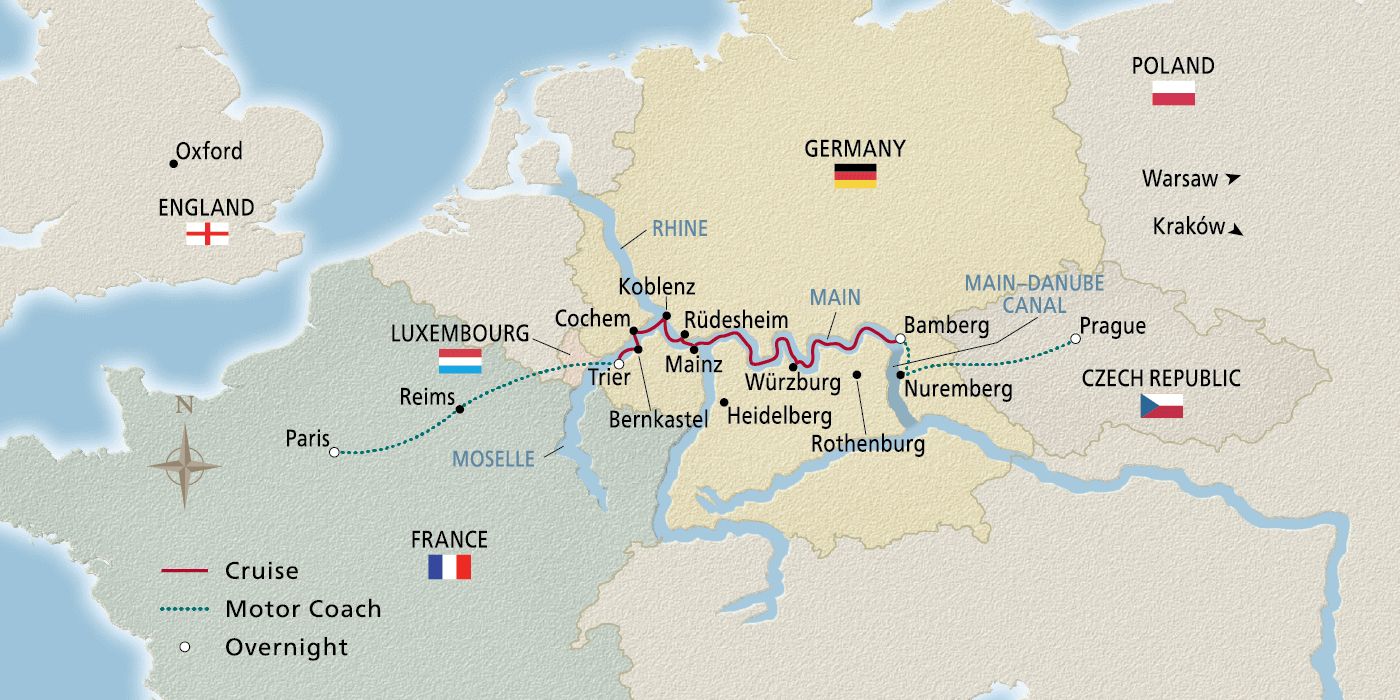
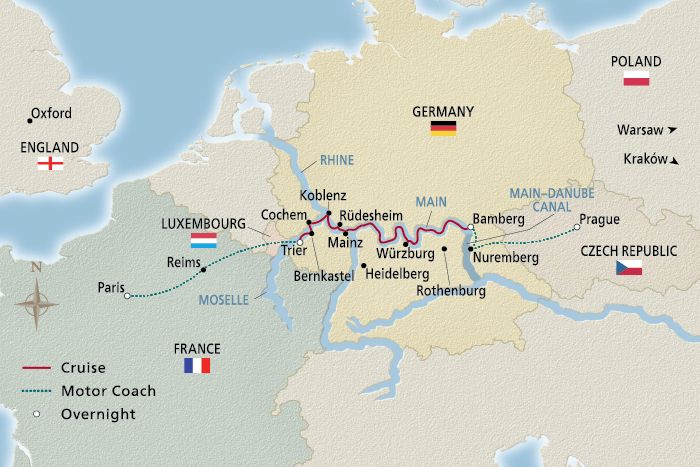
After breakfast, check out of your hotel and begin your journey to your embarkation city. Reims lies in the heart of France’s renowned Champagne region. A testament to its rich history, which can be traced back to Gallo-Roman times, is its diverse collection of landmarks. Among its most iconic are the Abbey of Saint-Rémi, the final resting place of the archbishop who baptized Frankish king Clovis and initiated Reims’s long line of coronations; the Palace of Tau, an archiepiscopal residence constructed in the Middle Ages; and Reims Cathedral, where 25 kings of France were coronated. These three monuments were collectively inscribed as a UNESCO World Heritage Site in 1991.
One of Germany’s most treasured cities for its rich history, Trier was once the regional capital of the Holy Roman Empire. After Emperor Constantine the Great had a vision of Christ, he and his mother Helena built great churches and cathedrals here. A few still stand, the magnificent Romanesque Cathedral of Trier among them. The 20,000-seat amphitheater, the Roman Bridge and the massive Porta Nigra, the ancient city gate, are further relics of that time. Today, Trier is a picturesque town surrounded by forests and vineyards, known also as the birthplace of Karl Marx and as a vibrant university town. Embark your ship and settle into your stateroom.
One of Germany’s most treasured cities for its rich history, Trier was once the regional capital of the Holy Roman Empire. After Emperor Constantine the Great had a vision of Christ, he and his mother Helena built great churches and cathedrals here. A few still stand, the magnificent Romanesque Cathedral of Trier among them. The 20,000-seat amphitheater, the Roman Bridge and the massive Porta Nigra, the ancient city gate, are further relics of that time. Today, Trier is a picturesque town surrounded by forests and vineyards, known also as the birthplace of Karl Marx and as a vibrant university town.
Nestled between soft rolling hills and the gently flowing Moselle River, Bernkastel, the “Pearl of the Moselle,” boasts medieval squares laden with charming half-timbered houses and inviting lanes and alleys. For much of their history, Bernkastel and its sister town of Kues across the river stood worlds apart. A bridge united them in 1874, paving the way for actual unification in 1905. Today, Bernkastel plays the charming host with history to share, while Kues pours the wine, more attentive to the sweet grapes of its fertile valley. Indeed, the twin towns produce some of Germany’s finest vintages.
Perched on a hilltop above the city and the Moselle, a 1,000-year-old imperial castle is the signature landmark of Cochem. Its mighty rectangular keep and many small towers strike a dramatic pose against a curtain of green hills. In Cochem’s lively Old Quarter, the market square boasts old timber-framed houses that overlook Martin’s Fountain and the bay-windowed baroque Town Hall. In this historic center, the 15th-century St. Martin’s Church and the Capuchin monastery, which now serves as an artistic and cultural center, are all beautifully preserved. Wine taverns along the river offer a “green wine,” a very young wine.
Koblenz is a traditional German city, founded more than 2,000 years ago. This former trading settlement rests on a massif of the Middle Rhine Highlands. Its cobblestone streets, wood-beamed houses adorned with flowers, ancient market square and medieval churches recall the fairy-tale Germany of old. At the “German Corner,” a massive equestrian statue of Prince William I observes the lovely riverside scene. The famed Teutonic Knights set up their first base here in 1216. The Romanesque Basilica of St. Castor, Koblenz’s oldest building, dates to 836.
The Rhine River flows through one of Germany’s most scenic regions. As you sail its most picturesque stretch, the UNESCO World Heritage Site of the Middle Rhine, you will pass vineyard-blanketed hills whose steep slopes require vintners to pick grapes by hand, keeping a centuries-old tradition alive. Splendid castles line the banks, all of which have stories to share, and the Lorelei Rock presides at a dramatic curve in the river. This infamous river maiden mesmerized sailors with her song and lured them to their demise at her feet.
Germany’s oldest university town, Heidelberg is situated in the Neckar Valley just east of the Rhine. Known as the cradle of the German Romantic movement, it also boasts beautiful baroque architecture. Heidelberg is most famous as the site of the imposing Heidelberg Castle. A magnificent red sandstone ruin perched 330 feet above the river, it was home to the Palatinate princes until it was partially destroyed by fire in the 17th century. It has been said that Heidelberg’s cityscape is so beautiful and so admired that American forces deliberately chose to avoid bombing it during World War II.
Surrounded by Franconian vineyards, Würzburg was heavily damaged during World War II, but has since been completely restored. This prestigious university city is a jewel of baroque architecture. Its most pristine example of pomp and glory is the great Bishops’ Residenz palace, built in 1744 for the prince-bishop; his unwavering support of artists is evidenced by the sweeping staircase and magnificent ceiling frescoes by Tiepolo. Other landmarks include the medieval, statue-lined Old Main Bridge and Marienberg Fortress, originally a Celtic hill fort and later residence of the bishops. The city remains a major wine-making center, hosting Germany’s oldest and largest vineyard.
Journey along one of Germany’s most important waterways today, passing landscapes that embody the country’s scenic beauty and storybook charm. You will sail by quaint riverside villages, undulating farm country and the sylvan forests of the Spessart woodlands. Along the way, you just may lose yourself in the dreamy canvases of half-timbered houses, historic castles and splendid palaces. This is the Germany once ruled by dukes and brought to magical life by the imagination of the Brothers Grimm, who grew up in the town of Hanau and wove fantastic tales from these banks.
Founded in 902, Bamberg remains a medieval-looking city known for its symphony orchestra and rauchbier, specialty smoked beer. The city’s winding streets are filled with baroque patrician houses and are home to the stunning 11th-century Cathedral of Holy Roman Emperor Heinrich II, housing his tomb and that of Pope Clement II. Bamberg is especially noted for its Altes Rathaus, or Old Town Hall, situated on a twin-arched bridge over the Regnitz River, and for the old bishop’s houses: the 16th-century Alte Hofhaltung (Old Court) and 17th-century Neue Residenz (New Residence).
After breakfast, disembark your ship and transfer to your destination. The second-largest city in Bavaria, Nuremberg is filled with traditional half-timbered houses and Gothic churches with intricate spires. Although nearly destroyed during World War II, the remaining medieval city walls stretch some three miles and feature original gateways and 80 original watchtowers. Nuremberg is well known historically for its metal and toy craftsmanship. But it is infamous for its role in World War II, first as the site of Zeppelin Field’s Nazi rallies and later as the site of the war crimes trials at the Palace of Justice that captured the attention of a generation. Transfer to your hotel and settle into your room.
Arrive and check in to your hotel. Prague is known as the “City of a Hundred Spires” and it is easy to see why. The towering twin steeples of Týn Church and the beautiful baroque Church of St. Nicholas are among some of the city’s most notable. Best explored on foot, Prague’s Old Town is a maze of ancient cobblestone lanes with the Old Town Square at its core. Here, the medieval Astronomical Clock still chimes today and provides for its viewers a little theater with the “Walk of the Apostles” on the hour, every hour.
Prague is known as the “City of a Hundred Spires” and it is easy to see why. The towering twin steeples of Týn Church and the beautiful baroque Church of St. Nicholas are among some of the city’s most notable. Best explored on foot, Prague’s Old Town is a maze of ancient cobblestone lanes with the Old Town Square at its core. Here, the medieval Astronomical Clock still chimes today and provides for its viewers a little theater with the “Walk of the Apostles” on the hour, every hour.
Few cities embody the past as authentically as Prague, the Czech Republic’s atmospheric capital on the Vltava River that clings to its history with unwavering passion. Prague’s medieval architecture is its most prominent, but the city is also a rich repository of Romanesque, baroque and art nouveau buildings that stir the imagination. The city’s graceful, pedestrian-only Charles Bridge served as the coronation route of the kings of Bohemia across the river to Hradčany Castle and its rich complex of royal buildings. Bid farewell to your fellow guests and journey home. Or spend more time exploring, perhaps joining one of our extensions.
Air Pricing
Prices are per person for featured departures.
Airfare offers valid on all N. American gateways except Alaska, Hawaii, San Juan and Mexico City.
Boston, Chicago, Dallas/Ft. Worth, Los Angeles, New York, San Francisco, Washington D.C.
Many additional gateways available, air fares may vary; call for details.
FREE Airfare
Offer valid on bookings made by December 21, 2025. FREE airfare, Reduced fares & FREE Stateroom Upgrades (Cat F to Cat E, Cat D to Cat C and Cat B to Cat A), C to B on Magnificent Mekong and CAT V1-DV1) on New Orleans Southern Charms only applicable to select departures of featured itineraries during stated sailing period. Offer is based on inventory availability at the time of purchase. 2026: Pay in by February 6, 2026. Free and Reduced Air offers not valid when booked from gateways in Alaska, Hawaii, Puerto Rico, or Mexico. Reduced Air offers vary by selected Air gateway in the country of residence. Airfares may vary on other gateways & departures. Air does not have to be purchased to receive cruise/cruisetour offer. Prices are based on double occupancy in US dollars and for US residents only. Offer may be withdrawn at any time without prior notice. All fares reflect cruise taxes, port taxes and fees. Not combinable with group contract pricing. Additional restrictions may apply.